Introduction
Artificial intelligence has moved rapidly from answering questions to taking action. What began with chatbots and generative AI assistants is evolving into a new generation of AI agents capable of planning tasks, accessing enterprise systems, making decisions, and executing workflows with increasing levels of autonomy.
For enterprises, the opportunity is significant. AI agents can streamline operations, accelerate decision-making, improve customer experiences, and automate complex processes that once required substantial human intervention.
But greater autonomy introduces a fundamental question:
If an AI agent can access enterprise systems and act on an organization’s behalf, who or what is allowed to decide what that agent can do?
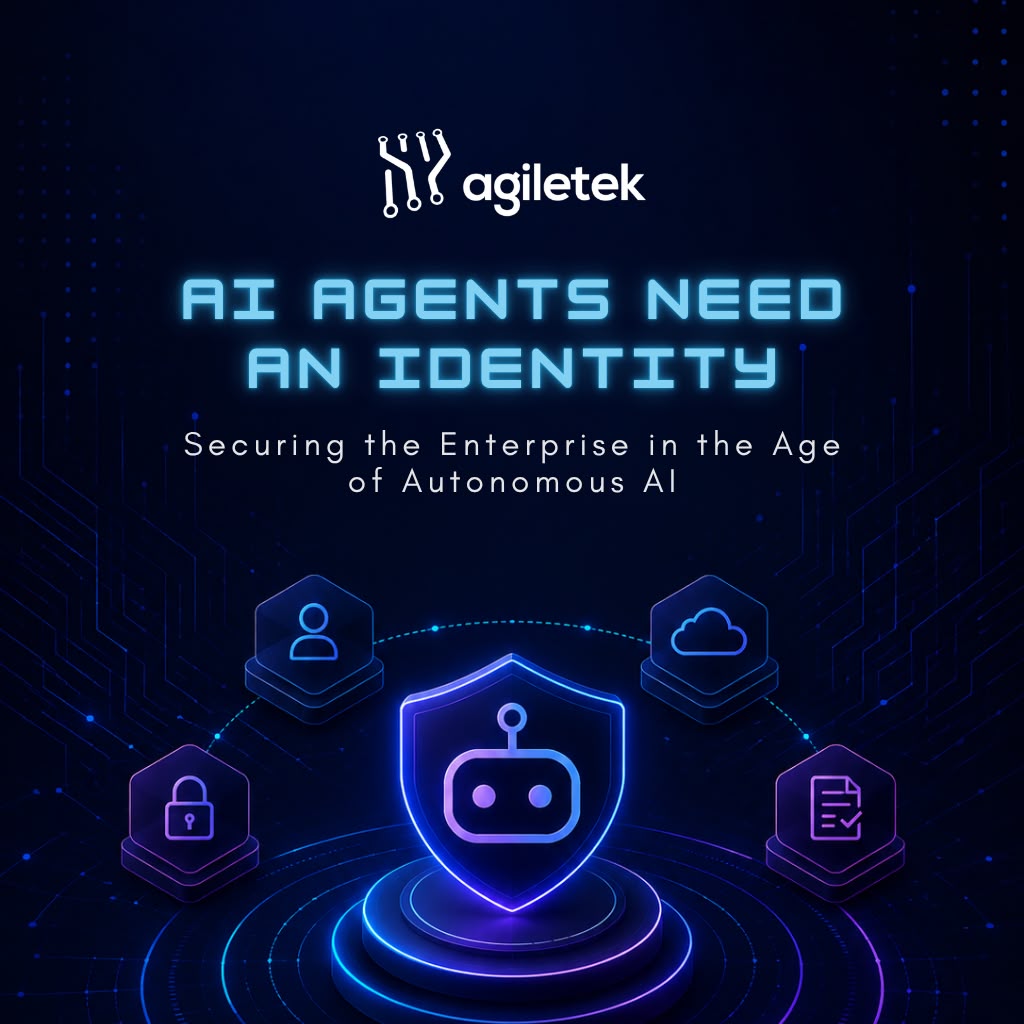
Traditional identity and access management was designed primarily around people, applications, and machines. Agentic AI introduces a new category of digital actor, one that can dynamically interact with data, applications, tools, and even other agents.
As enterprises move toward autonomous AI, identity can no longer be an afterthought. It must become part of the architecture.
From Users and Applications to Agents and Actions
For decades, enterprise security has relied on a relatively familiar model where users access applications to work with data. Identity provides the foundation, users authenticate themselves, receive defined permissions, and access the systems and information required to perform their responsibilities.
Agentic AI changes this model by introducing systems that do not simply retrieve or display information but actively execute tasks. In a modern enterprise environment, humans may delegate objectives to AI agents, which then interact with tools, applications, data sources, and even other agents to complete those objectives.
An AI agent may retrieve information from a database, interact with an enterprise application, initiate a workflow, communicate with an external service, and pass information to another agent, all as part of completing a larger goal. In this context, the agent is no longer simply generating information. It is executing intent.
This creates a new security challenge. Organizations must understand not only who has access, but also which agents can act, what they can access, what actions they can perform, and under whose authority they are operating.
Standards bodies such as NIST have already highlighted these challenges as an emerging area of enterprise security, emphasizing the need for proper identification, authorization, auditing, and non-repudiation controls for AI agents.
When an AI Agent Becomes a Digital Actor
Consider a simple enterprise scenario in which an employee asks an AI agent to resolve a delayed customer order. From the user’s perspective, this is a single request. From the system’s perspective, it becomes a coordinated sequence of actions across multiple enterprise systems.
The agent may retrieve the order from an ERP system, check inventory and shipment information, review the customer’s history in a CRM platform, contact a logistics provider, initiate a replacement shipment, issue a refund within an approved threshold, update the customer record, and close the service ticket.
What appears simple to the user is, in reality, a chain of decisions and actions spanning multiple systems, each requiring different levels of access and authority.
This raises important questions about which permissions the agent used, who authorized those permissions, whether the agent was allowed to make each decision independently, whether the organization can reconstruct exactly what happened, and who is ultimately accountable if the outcome is incorrect or unauthorized.
As enterprises move toward more autonomous operations, these questions become central to security and governance.
The Five Foundations of Agent Identity
Building trust in autonomous AI requires organizations to rethink identity and access management around the behavior and lifecycle of agents. Identity becomes the foundation for control, accountability, and governance.
The first foundation is identity itself. Every AI agent operating within an enterprise environment should have a distinct and verifiable identity. Organizations need to know which agent is accessing a system, what version of that agent is operating, which business function it belongs to, and what human or system initiated its activity. Shared or indistinguishable credentials undermine accountability and should be avoided.
The second foundation is authorization. While authentication establishes identity, authorization defines what the agent is allowed to do. An agent that can read customer information does not automatically need permission to modify records, and an agent that analyzes invoices does not necessarily require authority to approve payments. Authorization must therefore be granular and aligned with the agent’s intended purpose.
The third foundation is least privilege. This principle becomes even more critical when systems can act autonomously. Agents should only receive the access required to complete their assigned tasks. This includes carefully separating read and write permissions, distinguishing between analysis and execution capabilities, and differentiating between low-risk and high-risk actions. In some cases, human approval should still be required for sensitive operations.
The fourth foundation is monitoring. Observability for AI agents must go beyond traditional system health checks. Organizations need visibility into what the agent accessed, which tools it used, what decisions it made, which systems it interacted with, what actions it executed, and whether its behavior deviated from expected patterns. This level of monitoring is essential in environments where agents dynamically determine how to complete tasks.
The fifth foundation is auditability. Trust requires the ability to reconstruct events with precision. A robust audit trail should clearly show who initiated a request, which agent acted, what information it accessed, what decisions it made, what actions it performed, and which systems were affected. Without this level of traceability, organizations may gain powerful automation but lose the ability to govern it effectively.
Extending Zero Trust to AI Agents
The rise of AI agents extends the principles of Zero Trust beyond traditional users and applications. The core idea that no entity should be trusted by default remains valid, but it must now apply to autonomous systems as well.
Every agent must be authenticated, every request must be evaluated, every permission must be justified, every sensitive action must be monitored, and every interaction must be attributable. This does not eliminate autonomy. Instead, it ensures that autonomy operates within clearly defined and continuously verified boundaries.
The goal is not to reduce the capabilities of AI agents but to ensure that their actions remain controlled, observable, and accountable.
Building an Agent-Ready Security Architecture
Organizations preparing for widespread adoption of agentic AI need to establish a security architecture that supports identity, authorization, least privilege, monitoring, auditability, and governance as integrated capabilities rather than isolated controls.
This requires coordination across cybersecurity, enterprise architecture, application development, data governance, and business teams. In practice, organizations should move toward dedicated identities for AI agents, fine-grained access controls, short-lived credentials where appropriate, and a clear separation between data access and action privileges.
Continuous monitoring of agent behavior, comprehensive logging of all actions, human approval for high-impact decisions, and regular reviews of permissions are also essential. Security testing should be embedded throughout the agent lifecycle rather than applied only after deployment.
As these capabilities mature, disciplines such as DevSecOps, identity security, cloud security, data governance, and AI governance increasingly converge into a unified model for managing autonomous systems.
The Governance Challenge
Technology alone cannot determine how much autonomy an organization should grant to AI agents. That decision ultimately belongs to business and governance stakeholders.
Different tasks require different levels of oversight. An agent that summarizes internal reports may operate with minimal controls, while an agent that modifies production systems, approves financial transactions, or interacts with sensitive external environments requires significantly stronger safeguards.
A practical way to manage this complexity is through risk-based autonomy levels. In an assist model, the agent recommends actions while a human executes them. In an approval model, the agent prepares and initiates actions that require human authorization. In an execute model, the agent can complete predefined low-risk actions independently. In a fully autonomous model, the agent can plan and execute multi-step workflows within strictly defined boundaries.
This approach allows organizations to scale AI responsibly without forcing every use case into either fully manual or fully autonomous extremes.
The Future of Enterprise Identity
Enterprise identity has historically focused on people, then expanded to include applications, devices, services, and workloads. The next evolution will include AI agents as first-class digital identities.
As multi-agent systems become more common, agents will interact with other agents, delegate tasks, access external services, and dynamically assemble workflows. In such environments, it will no longer be sufficient to know that an action came from “AI.” Organizations will need to understand which AI system acted, under whose authority it operated, what permissions it used, which tools it accessed, what objective it was pursuing, and what evidence exists for its actions.
Identity therefore becomes more than an authentication mechanism. It becomes the foundation of trust across humans, software, and autonomous systems.
Conclusion: Autonomy Requires Accountability
The next phase of enterprise AI will not be defined solely by how intelligent AI agents become, but by how safely organizations can allow those agents to act.
Agentic AI has the potential to transform enterprise operations by shifting AI from a tool that provides insights to a system that executes outcomes. However, this transformation must not come at the expense of security, governance, and accountability.
Organizations that succeed will be those that treat agent identity and authorization as foundational elements of their AI strategy rather than as controls added after deployment.
At Agiletek, we believe the future of enterprise AI requires secure, governed, and resilient architectures that enable innovation with confidence.
The future of autonomous AI is not simply about giving agents more freedom. It is about giving them the right identity, the right permissions, and the right boundaries to earn trust.
Because when AI can act on your behalf, understanding what it is allowed to do is just as important as understanding what it can think.