Introduction
Artificial intelligence has rapidly evolved from an emerging technology to a strategic business imperative. Organizations across industries are investing heavily in generative AI, intelligent automation, predictive analytics, and AI-powered assistants to improve productivity, enhance customer experiences, and accelerate decision-making. While the opportunities are significant, many enterprises are beginning to encounter a new challenge that extends beyond AI adoption itself.
As AI initiatives expand across departments, organizations often find themselves managing a growing collection of tools, models, agents, and workflows that operate independently of one another. Human Resources may deploy AI for employee support, customer service teams may introduce virtual assistants, security operations may leverage AI for threat detection, and IT organizations may implement predictive capabilities to reduce downtime. Each initiative can generate value on its own, but together they often create a fragmented technology landscape that is increasingly difficult to govern, monitor, and optimize.
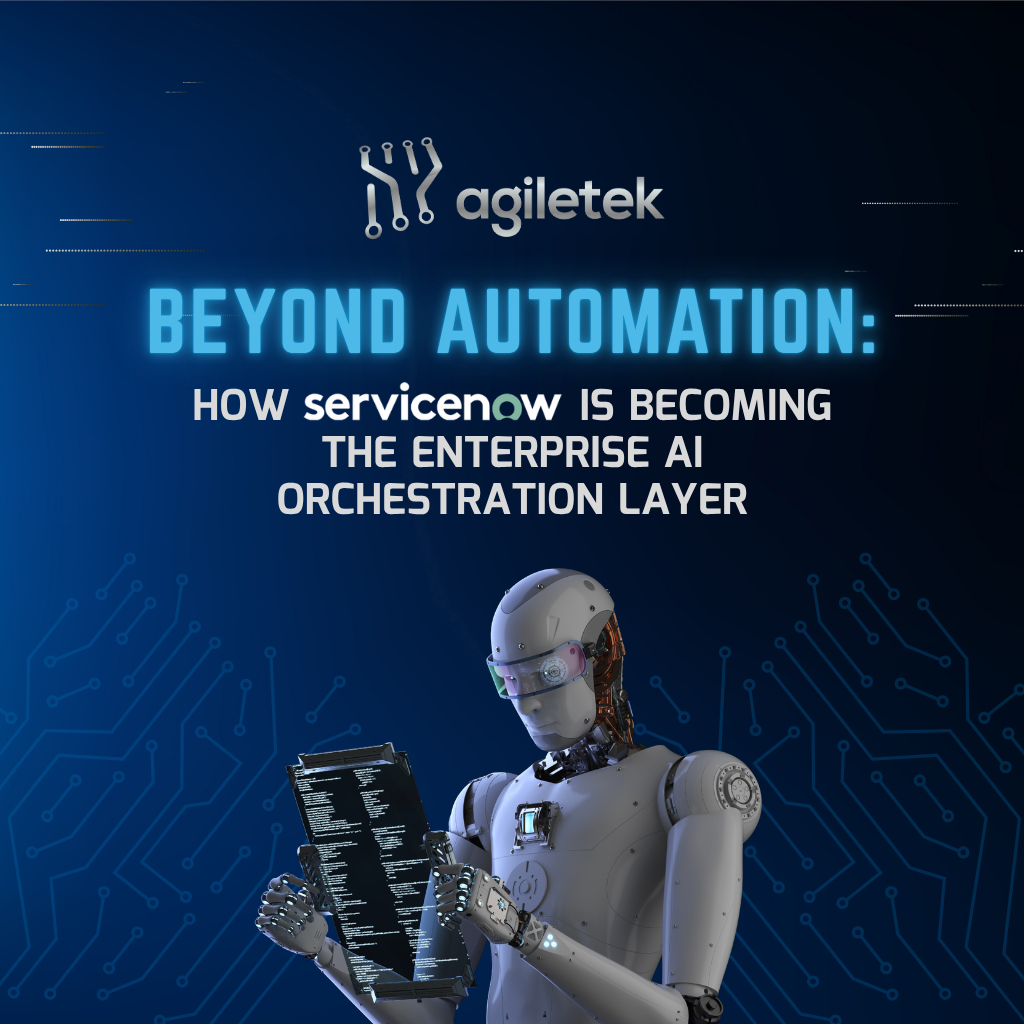
This emerging complexity is forcing organizations to rethink how AI is deployed and managed at scale. The next phase of enterprise AI is not simply about introducing more intelligent technologies. It is about creating a framework that allows those technologies to operate cohesively across the business. As enterprises move in this direction, ServiceNow is emerging as a platform capable of playing a much larger role than traditional workflow automation. It is increasingly becoming the operational layer through which AI, business processes, and human decision-making can be orchestrated across the enterprise.
The Growing Challenge of AI Fragmentation
Many organizations are experiencing a phenomenon that can best be described as AI fragmentation. Similar to the challenges businesses encountered during the early years of cloud adoption, AI initiatives are often launched independently by different departments, each pursuing its own objectives and selecting its own technologies.
While this decentralized approach can accelerate experimentation, it frequently introduces unintended consequences. Business leaders may struggle to gain visibility into how AI is being used across the organization. Different teams may establish their own governance standards, creating inconsistencies in risk management and compliance. Duplicate investments can emerge as departments implement overlapping solutions, while disconnected data environments limit the ability to generate enterprise-wide insights.
The issue is not that organizations are adopting too much AI. Rather, they are often adopting AI without a cohesive operational strategy. As the number of intelligent systems grows, so does the need for a centralized approach to oversight, coordination, and governance.
This challenge becomes even more significant as AI technologies continue to evolve. Organizations are no longer dealing exclusively with predictive models or simple automation tools. They are increasingly deploying intelligent agents capable of performing tasks, making recommendations, retrieving information, and interacting with users in sophisticated ways. These capabilities create tremendous business opportunities, but they also introduce new requirements for transparency, accountability, and operational control.
Why Traditional Automation Is No Longer Sufficient
For more than a decade, enterprise automation strategies focused primarily on eliminating repetitive tasks and streamlining workflows. Organizations used automation to reduce manual effort, improve consistency, and increase operational efficiency. The underlying logic was relatively straightforward. Rules were defined, processes were mapped, and automated systems executed predetermined actions.
Artificial intelligence fundamentally changes this model.
Unlike traditional automation, AI systems are capable of interpreting context, generating insights, and making decisions based on probabilities rather than fixed rules. Generative AI can create content, summarize information, and interact conversationally with users. Intelligent agents can perform multi-step activities and adapt their responses based on changing circumstances. Predictive models can identify patterns and recommend actions before issues occur.
These capabilities introduce a level of flexibility and intelligence that conventional automation cannot provide. However, they also create new questions for business and technology leaders. Organizations need to understand how AI-generated recommendations are produced, what data sources influence those recommendations, and where human oversight should be incorporated into decision-making processes.
As AI becomes embedded within critical business operations, enterprises must ensure that intelligent systems remain aligned with organizational objectives, compliance requirements, and risk management standards. This requires more than workflow automation. It requires orchestration.
The Rise of Enterprise AI Orchestration
The concept of orchestration is becoming increasingly important in discussions about enterprise AI. While automation focuses on executing tasks, orchestration focuses on coordinating systems, processes, data, and people within a unified operating model.
In practical terms, orchestration enables organizations to move beyond isolated AI deployments and create an interconnected ecosystem where intelligent capabilities work together to support business objectives. Rather than operating as standalone tools, AI solutions become integrated components of broader workflows that span departments and functions.
This shift is particularly important because enterprise value is rarely created by individual technologies operating independently. Value is generated when technologies work together to improve business outcomes. A customer service interaction may require information from multiple systems. A security incident may involve coordination between operations, compliance, and technology teams. An employee onboarding process may span HR, IT, facilities, and finance.
As AI becomes involved in these processes, organizations need a mechanism that ensures intelligence flows seamlessly across the enterprise while maintaining governance and visibility. Orchestration provides that mechanism.
ServiceNow’s Expanding Strategic Role
Historically, ServiceNow established itself as a leader in IT Service Management by helping organizations modernize workflows and improve operational efficiency. Over time, its capabilities expanded beyond IT to support functions such as Human Resources, Customer Service, Security Operations, Governance, Risk and Compliance, and Employee Experience.
This evolution has positioned ServiceNow at the center of many enterprise operations. Unlike point solutions that address specific business needs, ServiceNow often serves as the connective tissue between departments, systems, and processes.
That position becomes increasingly valuable in an AI-driven environment.
Because ServiceNow already facilitates workflow management across the enterprise, it is uniquely positioned to help organizations coordinate how AI capabilities are deployed and managed. Instead of allowing intelligent systems to operate in isolation, organizations can integrate them directly into existing workflows while maintaining oversight, governance, and accountability.
This represents a significant shift in how enterprises think about workflow platforms. The future role of platforms like ServiceNow extends beyond process automation. They are becoming operational environments where humans and intelligent systems collaborate to achieve business outcomes.
The Emergence of AI Agents and the Need for Governance
One of the most transformative developments in enterprise technology is the emergence of AI agents. Unlike traditional chatbots or automation scripts, AI agents can perform complex tasks, interact with multiple systems, retrieve information, and execute actions with varying degrees of autonomy.
As organizations begin deploying these capabilities, governance becomes a critical consideration.
Without appropriate oversight, autonomous systems may introduce operational risks, compliance concerns, and security vulnerabilities. Leaders need confidence that AI-generated actions align with organizational policies and regulatory requirements. They need visibility into how decisions are being made and mechanisms for intervention when necessary.
The challenge is not simply controlling AI. It is creating an environment where intelligent systems can operate effectively while remaining accountable to business objectives and governance standards.
This is where orchestration becomes particularly important. A centralized operational layer can provide the visibility, control, and consistency needed to manage AI agents at enterprise scale. It can ensure that intelligent actions occur within defined processes, approved workflows, and established governance frameworks.
As AI capabilities continue to mature, organizations that establish these foundations early will be better positioned to scale innovation without sacrificing trust or control.
Building an Enterprise AI Operating Model
Successful AI transformation requires more than technology implementation. It requires a deliberate operating model that aligns people, processes, governance, and innovation.
Organizations that achieve meaningful outcomes from AI typically approach deployment as a business transformation initiative rather than a standalone technology project. They recognize that governance cannot be treated as an afterthought. Instead, governance must be embedded within operational processes from the beginning.
Human oversight remains equally important. While AI can dramatically improve efficiency and accelerate decision-making, certain decisions require human judgment, particularly in areas involving compliance, security, customer trust, and strategic business priorities. The most effective organizations are not replacing human expertise. They are augmenting it.
Visibility also plays a central role. Executive leadership teams need a comprehensive understanding of how AI is being used across the organization, where value is being generated, and where risks may emerge. Without this visibility, it becomes difficult to manage AI as a strategic enterprise capability.
Most importantly, organizations must ensure that AI initiatives remain connected to measurable business outcomes. The objective is not simply to deploy intelligent technologies. The objective is to improve operational performance, enhance experiences, reduce costs, strengthen resilience, and drive innovation.
From Workflow Automation to Workflow Intelligence
The future of enterprise operations will be shaped by what can be described as workflow intelligence. In this environment, workflows do more than move information from one step to another. They become intelligent systems capable of understanding context, recommending actions, identifying opportunities, and continuously improving outcomes.
Organizations are already moving in this direction. Employees increasingly expect intelligent support systems that help them complete tasks more efficiently. Customers expect personalized and responsive experiences. Leadership teams expect faster access to insights and data-driven recommendations.
Meeting these expectations requires a new operational foundation. Enterprises need platforms capable of connecting AI, automation, governance, and business processes into a cohesive ecosystem.
ServiceNow’s evolution reflects this broader shift. Its expanding role within enterprise operations positions it to serve as a central orchestration layer where workflows, intelligent agents, business systems, and human decision-makers converge.
As organizations continue to invest in AI, the ability to coordinate these elements effectively will become a key differentiator. The companies that succeed will not necessarily be those that deploy the most AI. They will be the organizations that integrate, govern, and operationalize AI most effectively.
Conclusion
Enterprise AI is entering a new phase of maturity. The conversation is no longer centered on experimentation or isolated use cases. Instead, organizations are focused on scaling AI responsibly, governing it effectively, and ensuring that it delivers measurable business value.
This shift introduces a new challenge. As intelligent technologies become embedded throughout the enterprise, organizations need a way to coordinate systems, workflows, decisions, and governance within a unified operational framework.
AI orchestration is emerging as the answer to that challenge.
In this evolving landscape, ServiceNow is becoming more than a workflow automation platform. It is increasingly serving as the connective layer that enables enterprises to integrate intelligence into their operations while maintaining visibility, accountability, and control.
For organizations pursuing large-scale AI transformation, the future may not be defined by how many AI solutions they deploy. It may be defined by how effectively they orchestrate them.